Education
Experience
- Verilog / SystemVerilog
- Python
- C++
- JavaScript
- MATLAB
- Cadence Virtuoso
- Synopsys DC / PrimeTime
- Xilinx Vivado / Quartus
- ModelSim / XSim / Verilator
- Altium Designer
- 65nm TSMC CMOS
- FPGA & ASIC Design
- Digital & Analog Design
- RTL Verification
- SPICE / COMSOL
- LLM / Transformer RTL
- FPGA AI Acceleration
- Intel AI Tensor Blocks
- Electro-Optical Systems
- Linux / Git
5-Stage Pipelined RISC-V CPU
A fully functional 5-stage pipelined processor implementing the RISC-V ISA, written in Verilog. Supports the RV32I base integer instruction set with full pipeline hazard handling.
Designed for correctness and performance: data hazards are resolved via forwarding paths from EX and MEM stages, minimizing pipeline stalls. Control hazards use branch prediction with flush logic.
- IF → ID → EX → MEM → WB pipeline with full data forwarding
- Hazard detection unit with stall and flush control
- Register file with dual async read, synchronous write
- ALU supporting R-type, I-type, S-type, B-type, U-type, J-type
- Simulated and verified in ModelSim / On Board Testing
// Hazard detection + forwarding unit
module hazard_unit (
  input  [4:0] ID_EX_Rs1, ID_EX_Rs2,
  input  [4:0] EX_MEM_Rd, MEM_WB_Rd,
  input         EX_MEM_RegWrite, MEM_WB_RegWrite,
  input         ID_EX_MemRead,
  output reg [1:0] ForwardA, ForwardB,
  output reg       Stall
);
  // Load-use hazard: stall one cycle
  always @(*) begin
    Stall = ID_EX_MemRead &&
             ((ID_EX_Rs1 == EX_MEM_Rd) || (ID_EX_Rs2 == EX_MEM_Rd));
    // EX forwarding: most recent result
    ForwardA = (EX_MEM_RegWrite && EX_MEM_Rd == ID_EX_Rs1) ? 2'b10 :
               (MEM_WB_RegWrite && MEM_WB_Rd == ID_EX_Rs1) ? 2'b01 : 2'b00;
    ForwardB = (EX_MEM_RegWrite && EX_MEM_Rd == ID_EX_Rs2) ? 2'b10 :
               (MEM_WB_RegWrite && MEM_WB_Rd == ID_EX_Rs2) ? 2'b01 : 2'b00;
  end
endmodule
iBERT LLM Inference Pipeline
A hardware-accelerated inference pipeline for BERT-based language models, implemented in SystemVerilog. Designed to execute transformer attention blocks and feed-forward layers with minimal latency.
iBERT leverages integer-only arithmetic throughout the pipeline, eliminating floating-point operations from the critical path. Attention score computation, softmax approximation, and matrix multiplications are all mapped to fixed-point integer datapaths.
- Integer-only attention and computation blocks (iBERT quantization)
- Systolic array structure for matrix multiply acceleration
- Layer normalization approximation in integer arithmetic
- Parallelised multi-head attention processing
- End-to-end pipeline functional on Pynq FPGA
// Integer attention score computation — QK^T / sqrt(d_k)
module int_attention_core #(
  parameter D_K = 64,
  parameter SEQ = 128
)(
  input  logic clk, rst_n,
  input  logic signed [7:0] Q [0:SEQ-1][0:D_K-1],
  input  logic signed [7:0] K [0:SEQ-1][0:D_K-1],
  output logic signed [15:0] scores [0:SEQ-1][0:SEQ-1]
);
  logic signed [15:0] acc;
  integer i, j, k;
  always_ff @(posedge clk) begin
    for (i=0; i<SEQ; i++)
      for (j=0; j<SEQ; j++) begin
        acc = 0;
        for (k=0; k<D_K; k++)
          acc += Q[i][k] * K[j][k];  // INT8 dot product
        scores[i][j] <= acc >>> 3;      // approx /sqrt(64) via right-shift
      end
  end
endmodule
256-Bit Scan Chain
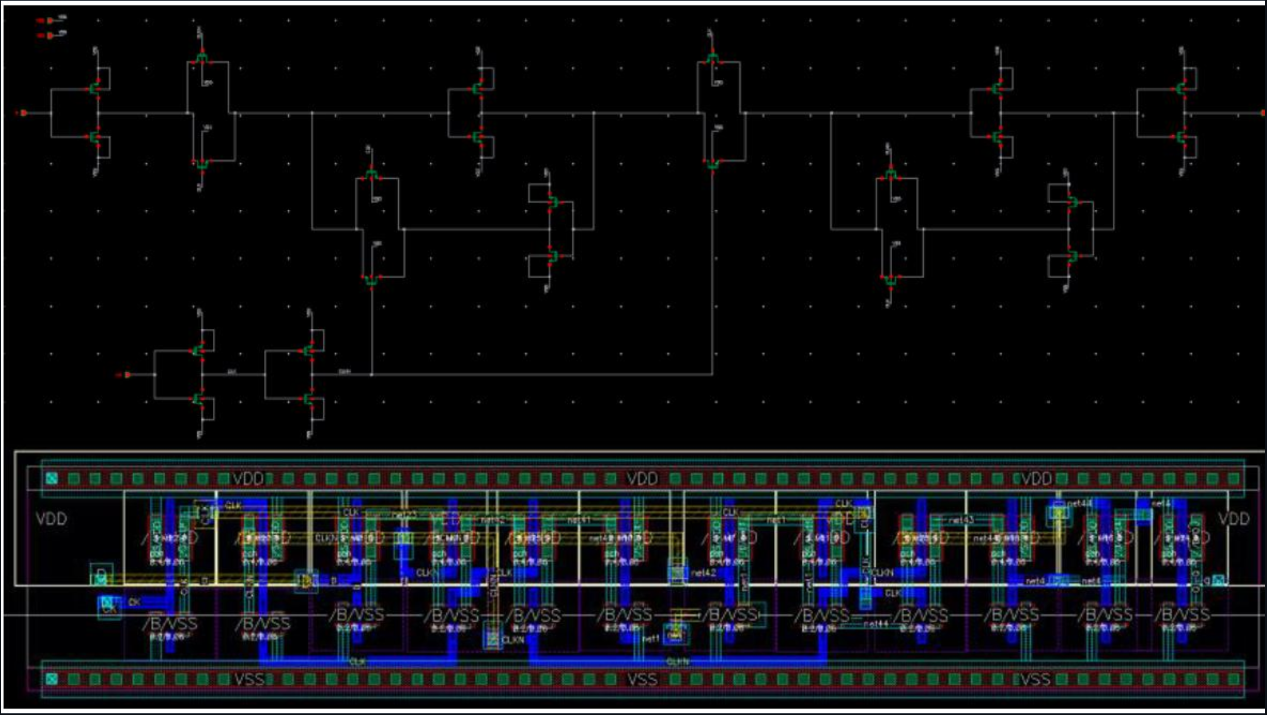
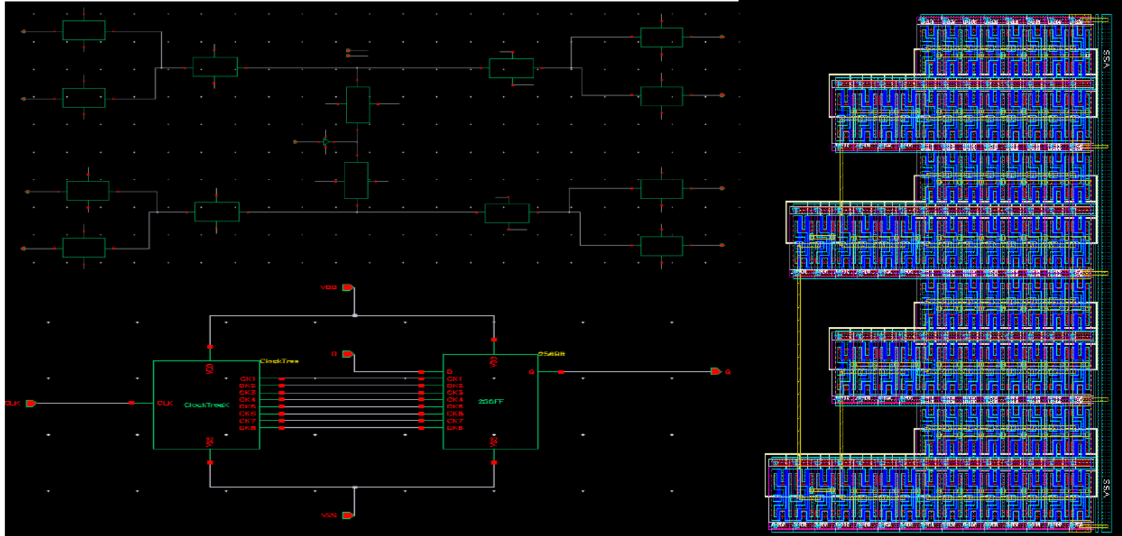
A 256-bit serial scan chain implemented and laid out in Cadence Virtuoso, designed as a Design-for-Test (DFT) structure to enable full controllability and observability of internal flip-flop states.
Each scan flip-flop is a modified D-FF with an additional scan input and a mode-select mux. In scan mode, all 256 FFs form a serial shift register, allowing test vectors to be shifted in and captured results shifted out.
- 256 scan-enabled D flip-flops in series
- Designed, simulated, and laid out in Cadence Virtuoso
- DRC and LVS clean layout with full connectivity verification
- Mode-select logic: functional mode vs. scan shift mode
- Supports shift-in, capture, and shift-out test sequences
0
1
2
254
255
Normal FF operation
Serial shift register
// Scan-enabled D flip-flop — core cell of the 256-bit chain
module scan_dff (
  input  wire clk,       // clock
  input  wire scan_en,  // 1 = scan mode, 0 = functional
  input  wire d,        // functional data input
  input  wire si,       // scan input (from prev FF)
  output reg  q,        // FF output
  output wire so        // scan output (feeds next FF)
);
  wire d_mux = scan_en ? si : d;  // select input based on mode

  always @(posedge clk)
    q <= d_mux;

  assign so = q;  // pass Q to next cell in chain
endmodule

// Instantiation across 256 cells
genvar i;
generate
  for (i = 0; i < 256; i++)
    scan_dff ff_inst (clk, scan_en, d_in[i],
      i == 0 ? SI : chain_q[i-1],  // SI chaining
      chain_q[i], chain_so[i]);
endgenerate
OpenVLA FPGA Acceleration
Accelerating the Meta OpenVLA vision-language-action model by mapping transformer MLP layers onto an Intel Agilex-5 FPGA using SystemVerilog, Quartus Prime, and Intel's FPGA AI Suite with AI Tensor blocks.
Characterised matrix dimensions, precision requirements, and data reuse patterns of each transformer layer to guide FPGA mapping and accelerator architecture decisions. Targeting 10% lower power and 5% higher throughput versus CPU baselines.
- Intel Agilex-5 FPGA target — AI Tensor block utilisation
- Transformer MLP layer mapping: dimension analysis and dataflow optimisation
- Mixed-precision strategy per layer to balance accuracy and resource usage
- Quartus Prime + Intel FPGA AI Suite for synthesis and placement
- Target: −10% power, +5% throughput vs CPU baseline
// MLP layer accelerator for OpenVLA on Intel Agilex-5
// Maps transformer feed-forward blocks onto AI Tensor blocks
module mlp_accelerator #(
  parameter D_MODEL = 4096,
  parameter D_FF    = 11008,  // LLaMA-style FFN hidden dim
  parameter PREC   = 8         // INT8 weights
)(
  input  logic                     clk, rst_n, valid_in,
  input  logic signed [PREC-1:0] x    [0:D_MODEL-1],
  input  logic signed [PREC-1:0] W1   [0:D_FF-1][0:D_MODEL-1],
  output logic signed [15:0]      out  [0:D_FF-1],
  output logic                     valid_out
);
  // Systolic tile — maps to Agilex-5 AI Tensor block primitive
  genvar i;
  generate
    for (i = 0; i < D_FF; i++)
      dot_product_unit #(D_MODEL, PREC) dp (
        clk, valid_in, x, W1[i], out[i], valid_out
      );
  endgenerate
endmodule